
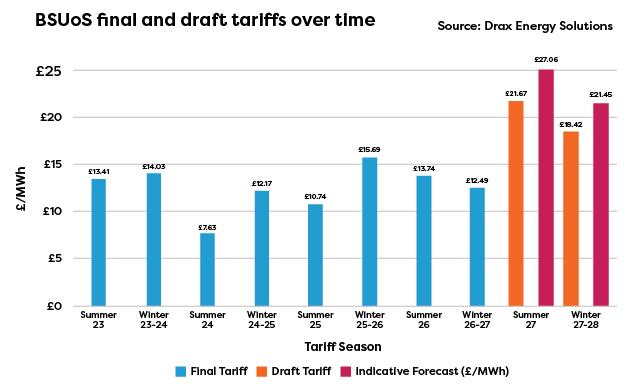
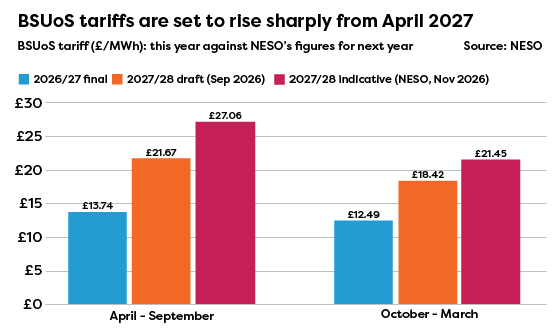
BSUoS (Balancing Services Use of System) is the passthrough cost to the consumer for balancing the electricity transmission system, currently charged at £13.74/MWh and £12.49/MWh for summer and winter this year. However, recent forecasts are indicating a significant rise to £27.06/MWh and £21.45/MWh from Apr-27 – almost double the current cost! As the below table highlights, the last few seasons’ tariffs have remained relatively stable but current draft tariffs show a sharp rise upcoming. The final tariffs for 2027 will be confirmed in December 2026.
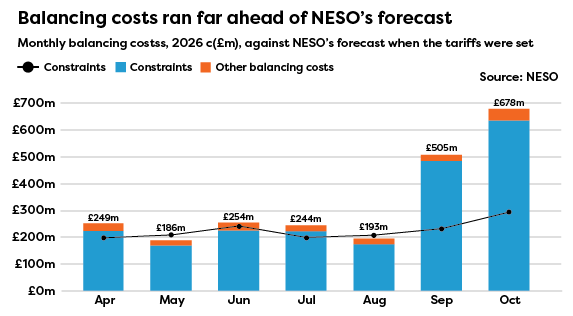
Infrastructure capacity limitation is the primary indirect cause of these costs. During periods of high renewable generation, said generators produce more energy than the surrounding area can consume and the infrastructure is able to support relocating. The surplus potential capacity, therefore, must be switched off. At cost. Generators continue to receive their full strike price when asked to nominate down due to oversupply, which has occurred at an above average rate this year due to planned outages for network reinforcement and high winds.
Areas of low renewable supply, therefore, receive their intake from a more-conveniently-located CCGT (Combined Cycle Gas Turbine), which converts gas into electricity. During the cost-setting period of December 2025, the market wholesale price averaged 67.9 p/therm for Apr-26 to Mar-27. Following Trump’s “It won’t be difficult” war with Iran, this has increased 161% to 177.5 p/them, as an average across available DA and remaining futures markets. Over the past year, gas has accounted for 24.9% of the grid’s electricity mix, but this hasn’t just impacted a quarter of the electricity price. In fact, thanks to marginal price setting, all units of electricity per half hour are charged at the most expensive rate of production, which is typically the cost for gas-fired generation. This combination of paying renewable generators to shut down combined with sky-high replacement gas costs results in the consumer paying for some units of power twice.
The result of inadequate infrastructure unable to cope with high renewable generation, and the ongoing war combined with marginal price setting has increased the cost of BSUoS beyond what was initially expected…
And, for our final problem: BSUoS charges are fixed on an ex-ante basis – prior to the year of delivery. The calculation to determine this cost rests on the forecasted costs of the upcoming year and the ex-post differential of the previous year. The expected upcoming increase in Apr-27 to Mar-28 hits harder due to the significant undercharging at present, compounded by forecasted increased costs of next year. The perfect storm.
Where do we go from here? The largest detriment to BSUoS costs has been the replacement gas-for-power generation caused by lacking infrastructure. The grid requires upgrading across key boundaries to ensure renewable generation can be produced to its full potential. While works have begun, this has reduced the current capacity temporarily during this improvement. Further, investment in Southern renewable generators would bypass this lacking infrastructure entirely and prevent the burning of fossil fuels and carbon emission release. And, finally, decoupling gas and power, and moving away from a marginal price setting system is the only way to reduce the volatility of our electricity resulting from global market risks.
If you are worried about increases to BSUoS or other non-commodity elements of your energy bills, then contact LG Energy Group today at info@lgegroup.com for more information on how the team can help!