
Following on from the recent publication of five-year forecasts for energy costs by the National Energy System Operator (NESO), LGE analyses the increases in costs being paid for the Transmission Network Use of System (TNUoS) charge from April 2026, the impact it could have on your business and how to mitigate against the forecasted increases.
What is the TNUoS Charge?
TNUoS is one of multiple charges that make up the non-commodity element of your energy bill. Non-commodity costs are charges that include a range of government and third-party charges and can account for around 60% of invoiced costs on an electricity bill and 40% on a gas bill.
TNUoS covers the cost of maintaining the UK energy system and accounts for 5-10% of an energy invoice. Alongside TNUoS other third-party charges on your bills include Distribution Use of System (DUoS) which is raised for maintenance and development of the National Grid and Balancing Services Use of System (BSUoS) which is raised to cover the costs incurred by suppliers based on the energy they take from the National Grid.
Why is the TNUoS Charge Set to Increase?
NESO has stated that there are two primary reasons for the increases to the TNUoS charge. These are:
- RIIO-3 Price Control Period– The RIIO (Revenues = Incentives + Innovation + Outputs) Framework is a set of price controls established by Ofgem to make sure that energy network companies treat consumers fairly and make relevant investments to support the transition to net-zero. The third period of price controls is set to begin in 2026 and run till 2031. Within this period a major focus is on network reinforcement which the TNUoS charge covers.
- Net-Zero Ambitions– A central reason as to why focus is being placed on network reinforcement is because of the UK’s net-zero ambitions. With the government’s Clean Power 2030 target large expansions to the UK’s renewable energy supply will have to be made. However, much of these projects will be in remote locations and transmitting the power from the projects to where it is needed requires significant upgrades, something which the TNUoS charge helps pay for.
How are TNUoS Charges Decided & How Much is it Increasing?
The TNUoS charges you face will be dependent on the band two factors:
- Your agreed capacity, measured in kVA (kilo-volt-amperes), which is the power allocated to a business in a local area, with higher charges for those in higher bands and greater kVA values allocated to them.
- The voltage level at which you receive your energy, this splits the banding between LV (low-voltage), HV (high-voltage) and EHV (extra high voltage). Sites connected at higher voltages are found in the bands with the most expensive charges.
With the forecasts published by NESO indicating it is looking to almost double the revenue generated in the previous years, significant increases to non-commodity charges have been forecasted. As the below table highlights increases across all bands are significant, with an average increase of 50%. This jump will be most acutely felt by large energy intensive users in the higher bands.
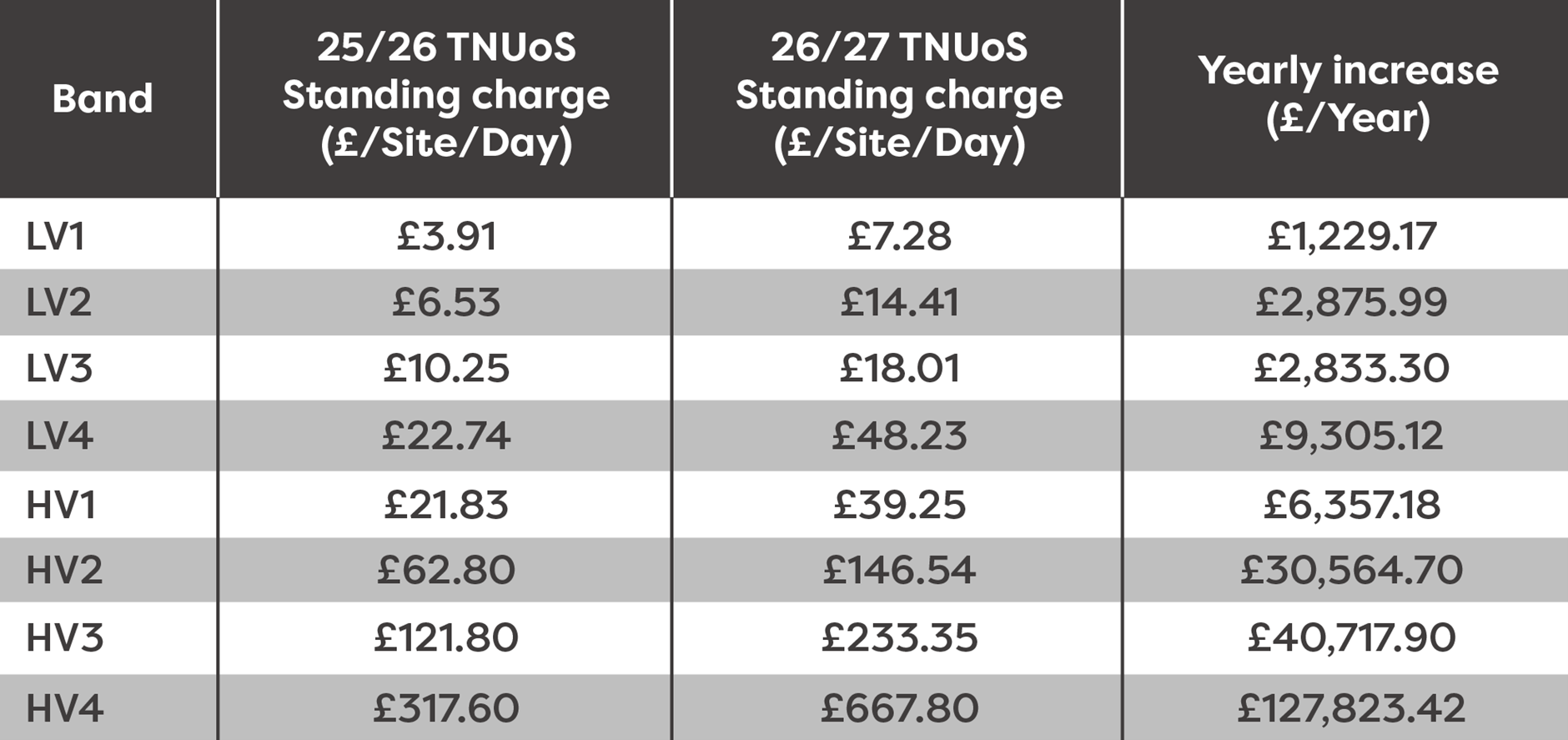
The final confirmed tariffs are set to be announced in January 2026, with Ofgem currently in the process of reviewing how it predicts TNUoS charges, hoping to produce a methodology that is more predictable and stable as the current volatility in forecasts is a real stress for businesses, not only impacting their profitability through large increases but also making it challenging to accurately forecast internal budgets.
Changes to Banding
For some businesses respite may come in the changes to kVA range bandings, with some potentially falling into lower bands meaning their increase will not be as significant as it would have been in previous years.
Example
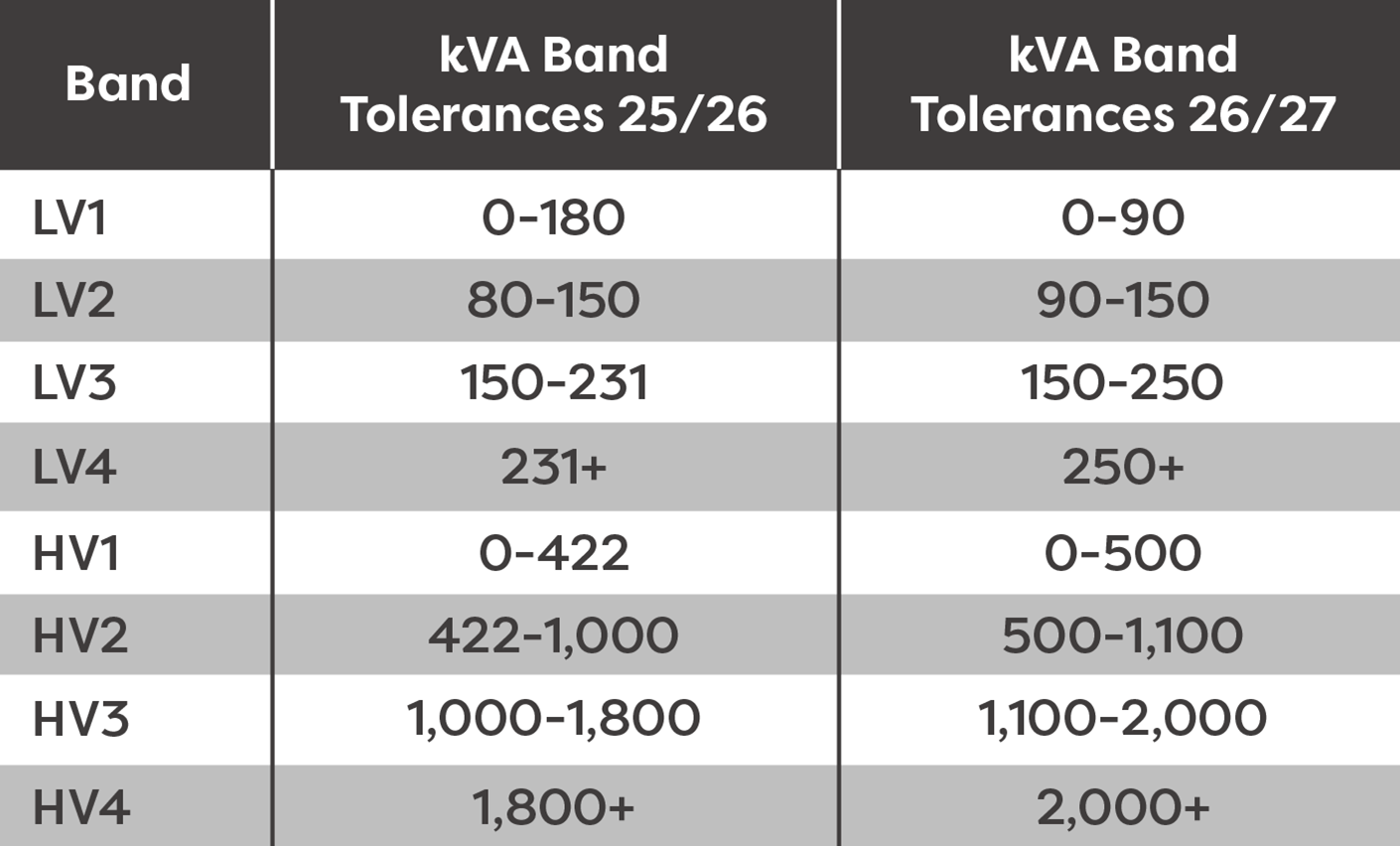
- A high-voltage consumer, with an agreed capacity of 450kVA in the 2025-2026 period would sit in HV2, the banding kVA threshold being between 422 and 1,000,
- For 2026-2027 the banding for HV2 has changed to a threshold of 500 to 1,100.
- This means that the 450kVA consumer would drop down into HV1 from HV2 for 2026-2027
- The consumer therefore avoids the increase of £30,564.70 and instead only face an increase of £6,357.18.
It is for this reason that is essential for a business to ensure that your kVA capacity is not higher than necessary and subsequently avoid being placed in a higher band and paying more costs than you should be. The below table highlights the full list of banding changes:
How LGE Can Help:
Options are available to limit the impact of increases to TNUoS and other non-commodity charges. LGE’s expertise in energy management & consultancy means it is here to support you through the following measures:
- Analysing the potential for capacity reductions allowing for consumers to drop charge bands and face a smaller increase in costs. LGE recently did this for a client in the plastics sector and helped achieve annual savings of £97,822. For a consumer to be eligible to drop bands it must meet the following two conditions:
- A reduction in capacity of over 50%
- A reduction that is due to a change of use or configuration, which is evidenced by a letter stating this signed by a director or the owner of the site.
- Ensuring that consumers receive all the support available to them, for example large energy users may be eligible to participate in the Energy Intensive Industries Compensation Scheme (EIIC) and obtain compensation of up to 100% on non-commodity charges, such as TNUoS. For the same client who LGE helped reduced capacity for, LGE also assessed their criteria for participation in the EIIC and once confirmed once produced a timely submission to receive the discount. This helped generated annual savings of £895,426 on non-commodity charges for the client.
- Effective procurement strategies which can help manage risk and reduce the commodity cost element of your bills, helping to offset any increases to non-commodity charges.
- Feasibility studies for technologies such as solar, battery and wind which can help reduce grid reliance and help reduce the amount of non-commodity charges being paid.
For more information on the increase to TNUoS charges or non-commodity costs broadly, speak to your account manager today or contact LGE at info@lgegroup.com.